
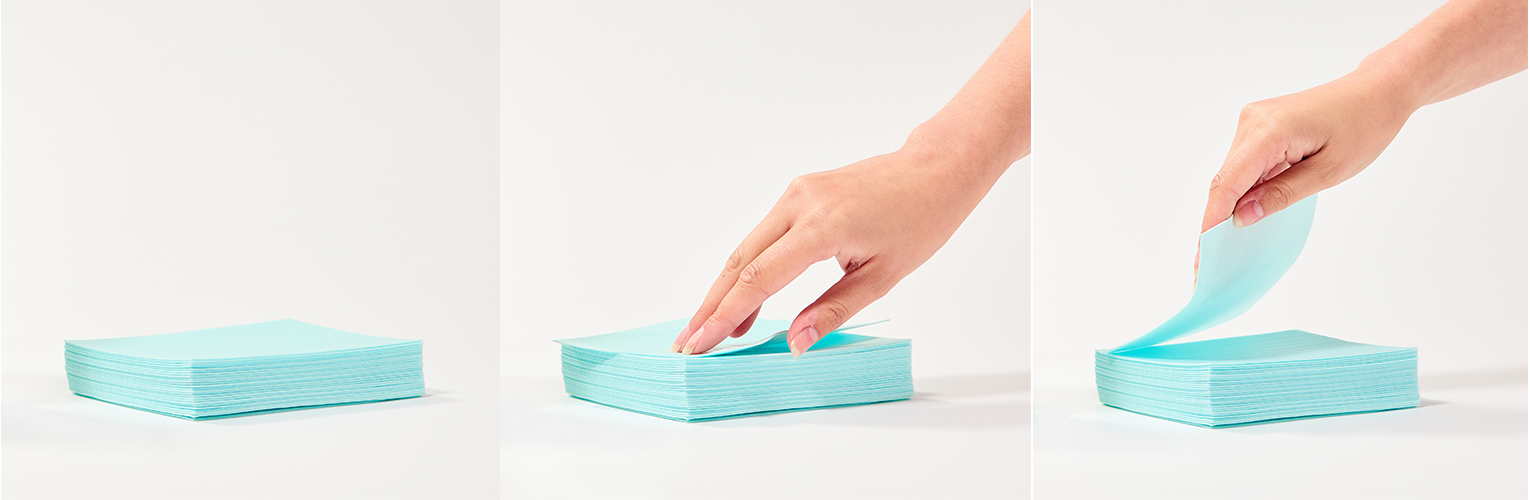
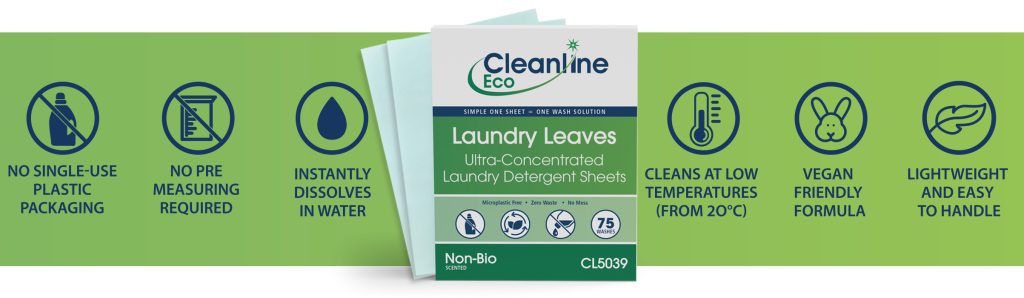
Discover a laundry revolution with Cleanline Eco Laundry Leaves – the eco-friendly alternative to traditional detergents. These sheets, up to 16 times lighter and significantly smaller, redefine efficiency and sustainability. Packaged in 100% plastic-free materials, they dissolve instantly, work at any temperature, and require no measuring. Join us in exploring the eco-friendly realm of laundry care. It’s time to revolutionize your laundry routine with Cleanline’s sustainable and user-friendly approach.
Chemicals
Many of the chemicals found in traditional laundry detergents are proven to harm aquatic life. Adding new chemicals for minimal return in efficacy has become common practice. Every single ingredient in a Cleanline sheet serves a purpose.
Some of the toxic chemicals often found in traditional laundry detergents include: Formaldehyde, 1.4-Dioxane, Nonoxynols, Phosphate, Phthalates, Benzene, Chlorine, & Nonylphenol
Ingredients in Cleanline Eco Laundry Leaves
| Sodium Dodecyl Sulphate | Surfactant | A traditional soap used in majority of laundry and other ‘mild’ detergents |
| PolyVinyl Alcohol | Soluble Polymer | This gives the sheet it’s structure, but readily dissolves in water |
| Sulfonic acid, C14-16-alkane hydroxy and C14-16 alkene, sodium salts | Surfactant | Typical surfactant used in the majority of laundry detergents. |
| Glycerol (glycerine, glycerine) | Plasticizer | Plant derived glycerine allows the sheet to be flexible not brittle. |
| D-Glucopyranose, oligomeric, C10-16 alkyl glycosides | Surfactant | variety of household and industrial applications |
| C12-16 Pareth-5 | Surfactant | Typical surfactant used in cleaning products and detergents. |
| Citric Acid | pH Modifier/antioxidant | A mild acid used to create a neutral pH in products, such as soaps, which are naturally alkaline. |
Plastic vs Cardboard Packaging
More than 70% of cardboard in the UK gets recycled and can be recycled over 20 times before the fibres become too weak.
Almost 50% of plastic waste in the UK is incinerated for energy recovery and only 12% actually goes through the recycling process. There are thousands of different types of plastic, and it’s expensive to sort and recycle. Additionally, it degrades after being recycled once or twice.
Liquids
Up to 80% of liquid detergent is water, which adds lots of unnecessary weight to a product, which in turn increases the product’s carbon footprint. Liquids traditionally come in plastic packaging. Although there is some movement in switching to cardboard, these usually have a plastic film to prevent leakages, making them difficult to recycle.
From a user-friendliness standpoint, liquids are heavy, they come in bulk packaging, dosages need to be measured and they are prone to spilling.
Pods & Capsules
Similar to traditional liquid detergents pods, and capsules are up to 80% water, adding to their weight. Whilst the need for measuring is negated by the individual wraps, the film around the pods does not properly dissolve at low temperatures and can leave a residue on clothes and in the machine.
Due to the issue with the film not dissolving in low temperatures, pods and capsules are harder to use at lower temperature, and hot water uses 90% of the energy used to run your washing machine. The Journal of Environmental Research and Public Health found that up to 75% of the wrapping from pods can make it into our oceans.
Powder
Despite powder often coming in cardboard packaging, the actual format itself poses several issues.
Although certain industries, such as health care and hospitality, will carry on washing at a higher temperature for the foreseeable future, we are in general being encouraged to lower our washing temperature. Powders do not dissolve as quickly or easily at lower temperatures.
This feeds into the biggest issue with powder, which is the amount of microfibers it pulls off our clothes and fabrics. The sharp granules of powder are more abrasive and therefore cause a higher amount of microfibres per wash. Microfibers from our washing have been found in our oceans in high volumes, with an estimated 13,000 tonnes every year coming from Europe alone.
In conclusion, Cleanline Eco Laundry Leaves mark a pivotal shift towards sustainable laundry. By discarding traditional formats for these lightweight, eco-friendly sheets, we reduce carbon emissions, eliminate plastic waste, and embrace a chemical-free approach. With just one sheet per wash, Cleanline streamlines the process offering cleaner laundry and more eco-conscious solutions. Let’s champion this sustainable shift for a cleaner future.
Sources:
How is cardboard recycled: https://www.gwp.co.uk/guides/how-is-cardboard-recycled/
Powder does not dissolve easily + hot water energy usage https://www.consumerreports.org/appliances/laundry-detergents/smarter-liquid-or-powder-laundry-detergent-which-is-better-a6293416483/
Microfibres in ocean https://www.wired.com/story/whos-to-blame-for-plastic-microfiber-pollution/
https://www.ncbi.nlm.nih.gov/pmc/articles/PMC9734713/ https://www.bigblueoceancleanup.org/news/2022/12/21/microfibres-the-invisible-plastic-filling-our-oceans
Powder is more abrasive: https://www.eea.europa.eu/publications/microplastics-from-textiles-towards-a
Detergent chemicals: https://www.thebetterindia.com/234603/harmful-chemicals-laundry-detergent-you-should-avoid-the-better-home/
Pod residues https://www.rd.com/article/laundry-pods-bad-environment/


