


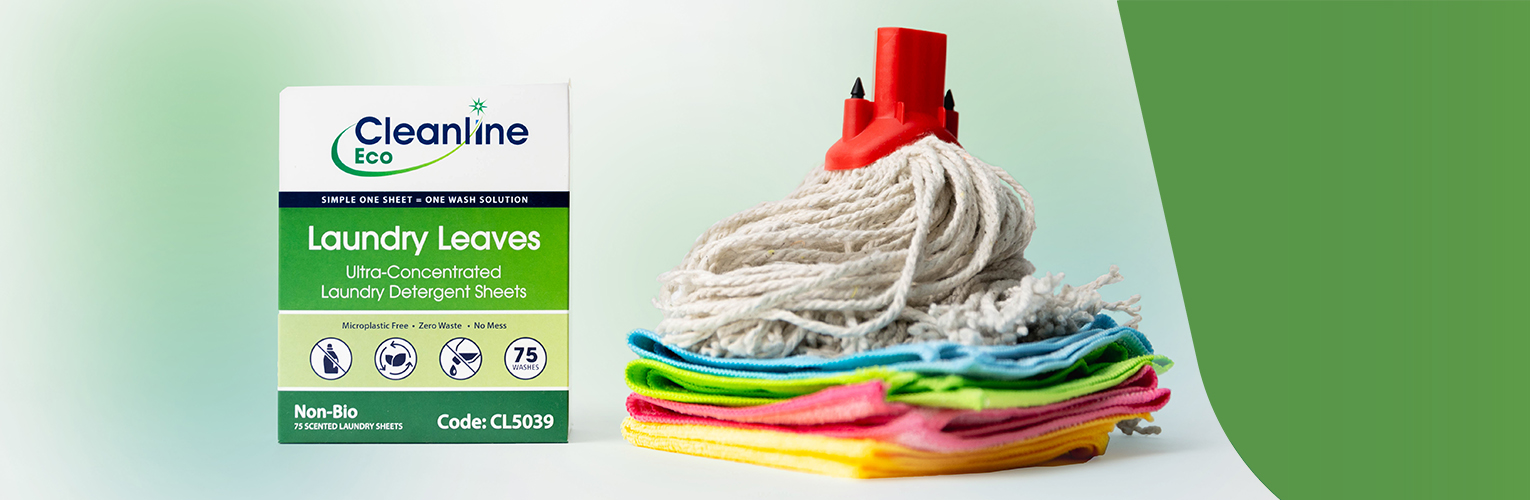
Look in any cleaning cupboard or trolley, and you will find microfibre cloths. And for good reason… They quite simply clean better, and can even reduce the need for harsh chemicals as a result. However, cleaning microfibre cloths can be challenging. Liquid detergent clogs up microfibres, whilst powder destroys the fine fibres, shortening the life of the cloths. In addition, many companies clean their cloths on site by handwashing, using detergents that are formulated for machine washing only.
Microfibre cloths should be a product that lasts, but unfortunately many get discarded after only a few uses. Not only is this bad for the environment, but it goes without saying that it adds unnecessary costs for companies, due to the need to buy more cloths. The solution is very simply to use a detergent compatible with microfibres. That’s where Cleanline Eco Laundry Leaves come in.
What makes Cleanline Eco Laundry Leaves different to other detergents?
With Cleanline Eco Laundry Leaves, microfibres can be washed again and again without getting damaged. As a format, the main benefits of sheets are usually quoted as being liquid-free, small and lightweight. However, the reasons laundry detergent sheets are so compatible with microfibres are their consistency in water and their dissolvability.
No other laundry detergent formats dissolve as quickly as sheets. This means that there is no need to worry about fragments getting caught in the microfibres before they’ve had the chance to fully dissolve. It also quickly mixes in with the water, without changing the water’s consistency. This allows the microfibre cloths to be washed without having any film of cleaning solution settle on and around the fibres.
Another benefit of Cleanline Eco Laundry Leaves, is that they have been formulated for both machine and hand washing. This negates the need to have two separate types of laundry detergents. It also eliminates the temptation to use a laundry detergent unsuitable for hand washing, which often exacerbates issues such as clogging and tearing of fibres when cleaning microfibre cloths.
How should you be washing your microfibre cloths?
Knowing how to clean your microfibre cloths is key to keeping their cleaning capability intact for longer. Choosing the right laundry detergent is obviously a big part of this, but so is the machine cycle, water temperature etc.
Before cleaning your microfibre cloths, make sure to shake off any excess dirt or dust. Whether you are washing your cloths by machine or by hand, you want to avoid washing with any other types of fibres – so keep them separate.
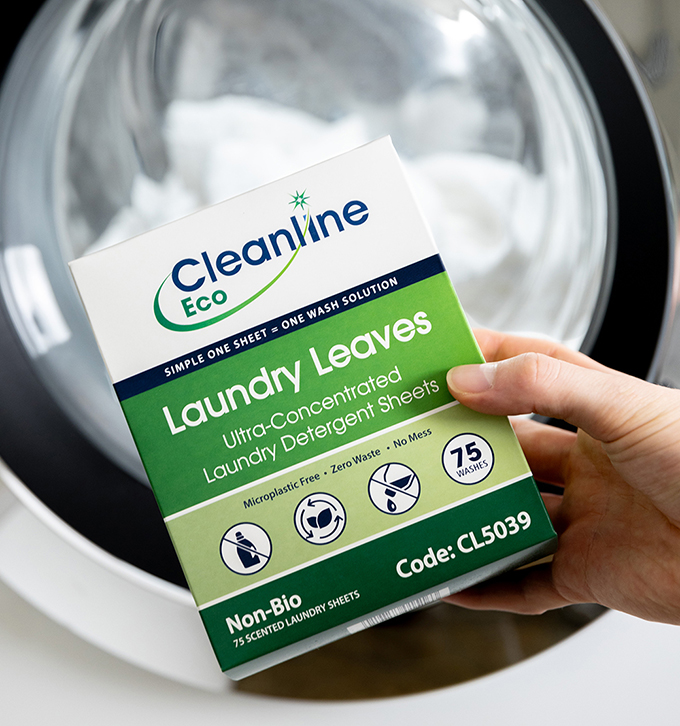
In the machine, choose a “gentle” or “delicate” cycle; this can be a cold or warm wash. Put a sheet of Eco Cleanline Laundry Leaves directly in the drum (use half a sheet if you are not filling up the machine). Do not use any conditioner as it will clog the fibres.
For handwashing, add the sheet to the water before adding the cloths, and let it dissolve fully.
Once you have washed the cloths, air drying is the best option, although microfibres can usually tolerate being tumble dried on a low heat. Do not use any dryer sheets.
Why traditional detergents are bad for microfibres
Now that we know how to clean microfibres properly and why Cleanline Eco Laundry Leaves work so well, let’s take a closer look at how and why traditional detergents cut their lifespan short.
Powder is still a popular choice, both in homes and in businesses. However, the considerable downsides to powders have become evident in the past couple of decades. Powder has low dissolvability, which means that a percentage of powder grains will remain intact for part of the wash cycle. This leaves them prone to getting caught in the fine microfibres. In addition, the jagged edges of powder grains actually tear at any fabric it comes into contact with. With microfibres being fragile, this leads to them being easily destroyed when washed with powder.
On the other hand, we have liquids, be it in bottles or capsules. Whilst there is no danger of the microfibres physically breaking or tearing, the consistency of liquid is usually a big problem. Liquid doesn’t fully mix with the water the way detergent sheets do, which leads to it settling on and around the microfibres, clogging them up.
Microfibres are a staple for any business carrying out cleaning services, and as such it’s important to know how to maintain them. As mentioned at the start of this article, properly cleaning microfibre cloths gives them a longer life, leading to both reduced costs and more environmentally friendly practice.


