
 Heralding a new era of disposable chemical protective garments
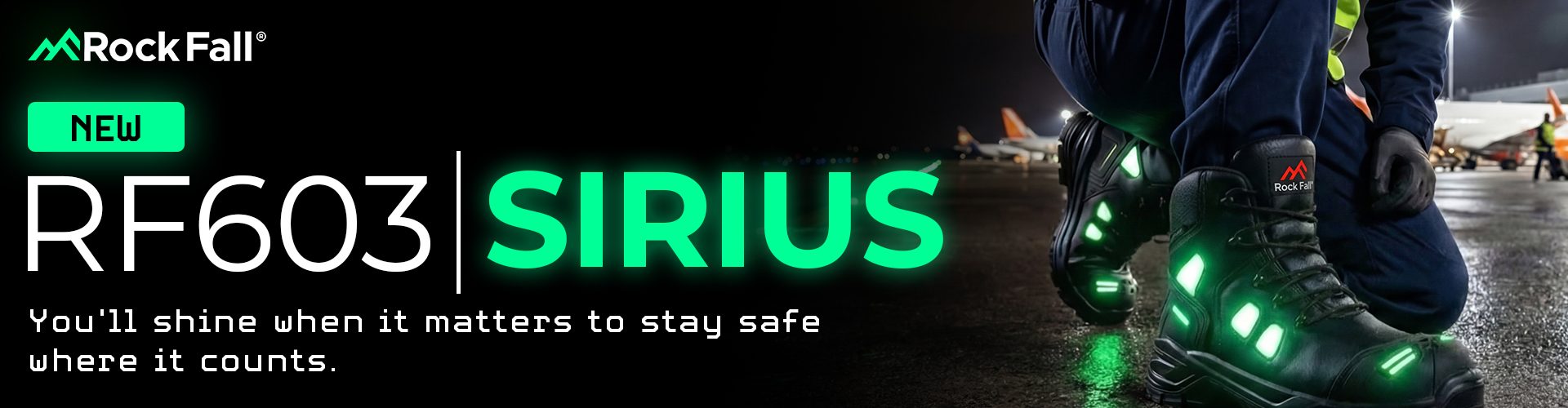
Phosphorescent safety footwear features glow-in-the-dark panels that charge in minutes and emit visible light for hours — without batteries. Using advanced photoluminescent materials, these boots absorb energy from sunlight or artificial light and release it as a continuous glow, keeping wearers visible in low-light and no-light environments where traditional reflective materials require a light source to work.
This guide explains how phosphorescent technology works, why it’s a significant advancement over reflective-only solutions, and how Coats® Signal™ Lucence™ dual technology is changing workplace visibility standards.
What Is Phosphorescent Safety Footwear?
Phosphorescent safety footwear incorporates photoluminescent panels that absorb light energy and emit a visible afterglow in darkness. Unlike reflective materials that passively bounce light back, phosphorescent materials actively generate their own light output.
The technology enables wearers to remain visible for up to 8 hours in complete darkness after just 5 minutes of light exposure — addressing a critical safety gap: the moments when there’s no external light source for reflective materials to reflect.
Features and Specifications
-
Charge Time – 5 minutes (natural sunlight) / 10 minutes (artificial light)
-
Glow duration – Up to 8 hours (without further light top-ups)
-
Power source – Light energy (self-charging)
-
Batteries required – None
-
Maintenance – Routine cleaning
-
Technology lifespan – Lifetime of footwear
Rock Fall’s Ultimate Visibility range — including the Sirius RF603 (code: 815121), uses this technology through a partnership with Coats® Signal™ Lucence™.
Understanding Photoluminescence
Photoluminescence is the emission of light by a material after it absorbs photons. The material doesn’t burn or change chemically; it converts absorbed light energy into visible light output. There are two types:
-
Fluorescence — light is absorbed and re-emitted almost immediately (nanoseconds).
-
Phosphorescence — light is absorbed, stored, and released gradually over minutes to hours.
The crucial difference is time. Fluorescent materials stop glowing the instant the light source is removed. Phosphorescent materials keep glowing long after, which is what makes them valuable for safety in darkness.
The glow comes from phosphors, crystalline compounds that store and release light energy. Modern safety applications use strontium aluminate phosphors, offering a brighter, longer-lasting afterglow than older zinc sulphide phosphors, plus greater stability and resistance to moisture and UV degradation. Strontium aluminate represented a 10x improvement over previous glow-in-the-dark materials, making practical safety applications viable for the first time.
Phosphorescence vs Fluorescence
-
Light emission timing – Immediate: Fluorescence; delayed (minutes–hours): phosphorescence
-
Glow duration – Only while lit: fluorescence; hours after charging: phosphorescence
-
Works in total darkness – phosphorescence
-
Requires continuous light – fluorescence and phosphorescence (only after initial charge)
-
Safety application – fluorescence has daytime visibility, phosphorescence has night/dark visibility
With fluorescent materials (like standard hi-vis yellow/orange clothing), electrons excite and immediately fall back to their ground state, releasing light instantly, but only while a light source (like UV) is present. With phosphorescent materials, excited electrons become trapped in a metastable state within the crystal lattice, releasing their energy gradually as light over hours. This trapping mechanism is what creates the extended afterglow.
For safety footwear, phosphorescence is essential because it provides visibility precisely when reflective and fluorescent materials can’t: in complete darkness with no light source at all.
The Science: How It Works
-
Light absorption — phosphorescent panels absorb photons from sunlight, artificial light, or UV.
-
Electron excitation — photon energy excites electrons, pushing them to a higher energy level.
-
Energy trapping — the strontium aluminate crystal structure traps these electrons in a metastable state, storing the energy.
-
Slow light release — ambient thermal energy gradually lets electrons escape, releasing stored energy as visible light.
This four-step process creates continuous light emission for up to 8 hours from a single 5-minute charge. The glow is brightest immediately after entering darkness and diminishes gradually, remaining visible throughout. Any additional light exposure during use effectively tops up the charge.
Signal™ Lucence™: Dual Technology Explained
Phosphorescence alone provides excellent no-light visibility, but full coverage across all lighting conditions requires more. Coats® Signal™ Lucence™ combines phosphorescent materials with retro-reflective panels, delivering three levels of visibility:
Level 1 – Fluorescence
Condition – Daylight
Level 2 – Retro-reflectivity
Condition – Artificial light present
Level 3 – Phosphorescence
Condition – No light / low light
Traditional hi-vis relies on levels 1 and 2 only, creating a risk gap when there’s no daylight and no artificial light. This gap commonly occurs between vehicle passes, during power outages, in remote locations, underground, and at dawn/dusk. Signal™ Lucence™ closes it by ensuring wearers emit their own light when all other visibility technologies fail.
On Rock Fall’s Ultimate Visibility boots, panels are positioned at 360-degree intervals — heel counter, side panels, and toe area, ensuring visibility from all angles.
Charging and Durability
Phosphorescent materials charge in minutes through simple light exposure, with no electrical charging required.
Light Source and time for Full Charge
-
Clear sunlight – 5 minutes
-
Cloudy daylight – 5 minutes
-
Dusk/dawn – 8 minutes
-
Fluorescent office lighting – 10 minutes
-
UV light source – 5–10 minutes
Charging is cumulative and works “on the go” — outdoor breaks, indoor-to-outdoor transitions, or pre-charging before entering tunnels or underground areas all contribute. Partial charges still work, and boots can’t be overcharged.
Signal™ Lucence™ panels are engineered to last the lifetime of the footwear, maintaining performance through thousands of charge/discharge cycles and resisting moisture, heat, UV, and abrasion. Maintenance is minimal: keep panels clean with warm water and mild soap, avoid harsh chemicals or abrasive brushes, and don’t cover panels with tape or paint. Like headlights on a car, dirt build-up reduces effectiveness. Clean panels perform best.
Real-World Performance
Phosphorescent boots remain visible at significant distances in darkness, from 50+ metres in the first 30 minutes down to 5–15 metres after 4–8 hours. Glow follows a predictable decay curve: brightest in the first 30 minutes, gradually dimming but clearly visible through the sustained phase (30 minutes–4 hours), and still discernible in the extended phase (4–8 hours).
Compared with reflective-only boots, the critical advantage is continuous visibility rather than visibility that depends entirely on an external light source — including in scenarios like power outages or when a worker is facing away from a light source.
Industries and Applications
Phosphorescent safety footwear delivers particular value across:
-
Highway maintenance — visible between vehicle passes, dawn/dusk work
-
Rail infrastructure — dark depots, tunnels, trackside
-
Utilities — underground access, night emergency response
-
Construction — night shifts, basement work, tunnelling
-
Warehousing — poorly lit areas, power outage protection
-
Agriculture — early morning/late evening work
-
Mining & quarrying — limited artificial lighting, emergency visibility
-
Emergency services — unpredictable lighting conditions
“It’s a great innovation. I don’t have to rely on the light catching me to be seen. The ‘always on’ light-emitting panels ensure that I’m fully visible in the dark throughout my shift.” — Offshore Oil & Gas Engineer
Meet the Ultimate Visibility Range at Greenham
Sirius RF603 (code: 815121) — a 5-inch ankle boot with 360° Signal™ Lucence™ phosphorescent and reflective panels, S7S waterproof rating. In stock and available to order & buy.
Frequently Asked Questions
What are phosphorescent safety boots? Protective work footwear that features photoluminescent panels that absorb light energy and emit a visible glow in darkness for up to 8 hours after a 5-minute charge.
Do glow-in-the-dark safety boots need batteries? No. They charge automatically from ambient light — sunlight, artificial lighting, or UV, with no batteries, cables, or electrical components to fail.
What’s the difference between phosphorescent and reflective boots? Reflective boots only work when light shines directly on them. Phosphorescent boots actively emit their own light in complete darkness. Signal™ Lucence™ combines both for full coverage.
How long does the technology last? Signal™ Lucence™ panels are designed to last the lifetime of the footwear, maintaining performance through thousands of charge cycles without degradation.
The Future of Workplace Visibility
Phosphorescent technology is a practical solution to a real problem, not a novelty. The gap between reflective technology’s requirements and real-world lighting conditions has always existed; phosphorescent materials finally close it.
With Coats® Signal™ Lucence™ dual technology, Rock Fall’s Ultimate Visibility solutions deliver complete coverage across all lighting conditions, zero maintenance visibility technology, no batteries or electrical failure points, and proven performance lasting the lifetime of the footwear.
When the light fades, you won’t.


