

Protecting Your
Hearing
Finding the Right Balance This World Hearing Day
World Hearing Day, observed annually on 3rd March, serves as a crucial reminder that hearing loss remains one of the most preventable occupational health issues. Yet according to recent Health and Safety Executive (HSE) statistics, approximately 17,000 workers in Great Britain are estimated to suffer from work-related hearing problems, with deafness or hearing loss accounting for a significant portion of ill-health cases reported under RIDDOR.
The message is clear: workplace noise is still causing irreversible damage to workers’ hearing across multiple industries. But while the importance of hearing protection cannot be overstated, there’s a less-discussed danger that deserves equal attention—over-protection.
The Hidden Risk of Over-Protection
When it comes to hearing protection, more isn’t always better. Over-protection occurs when workers wear hearing protection that reduces noise levels too much for their working environment.
This creates several serious safety risks:
Isolation from critical sounds:
Workers may be unable to hear warning signals, alarms, approaching vehicles, or emergency announcements—all of which are vital for workplace safety.
Communication breakdown:
Excessive noise reduction makes it difficult for team members to communicate effectively, leading to misunderstandings and potential accidents.
Reduced situational awareness:
Workers lose the ability to hear environmental cues that help them understand what’s happening around them, such as machinery malfunctions or colleagues calling out warnings.
Non-compliance:
Ironically, workers who find their hearing protection too isolating often remove it entirely, leaving themselves completely unprotected during high-noise exposure.
The Value of Personal Attenuation Testing
While manufacturers provide Single Number Rating (SNR) for hearing protection devices, these laboratory-tested values don’t always reflect real-world performance. This is where personal attenuation testing becomes invaluable.
Personal attenuation testing measures the actual noise reduction achieved by individual workers wearing their specific hearing protection in their actual working environment. This testing offers significant benefits:
Verification of proper fit:
Studies consistently show that improperly fitted hearing protection can reduce effectiveness by 50% or more. Attenuation testing immediately identifies fit issues,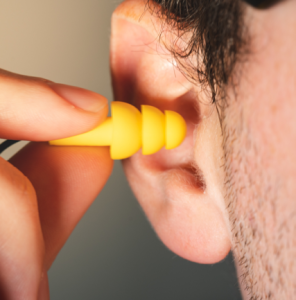 allowing workers to be retrained or switched to more suitable devices before damage occurs.
Individual variation:
Everyone’s ear canals are different, and insertion technique varies between workers. Testing reveals whether each person is achieving adequate protection with their chosen device, rather than assuming the manufacturer’s rating applies universally.
Identification of over-protection:
Testing can reveal when workers are wearing protection that attenuates too much for their environment, enabling you to select devices that provide adequate protection without unnecessary isolation.
 Enhanced worker confidence and compliance:
When workers can see measurable proof that their hearing protection is working effectively, they’re more likely to wear it consistently. Understanding their personal protection level also empowers them to take ownership of their hearing health.
Regulatory compliance:
Documented attenuation testing provides tangible evidence that employers are meeting their duty of care obligations and taking practical steps to protect workers, which is particularly valuable during HSE inspections or investigations.
Cost optimisation:
By identifying which types of protection work best for different roles and individuals, businesses can make informed purchasing
decisions rather than defaulting to the most expensive options or buying ineffective bulk products.
Training effectiveness:
Testing highlights whether your hearing protection training program is working. Consistently poor results across multiple workers indicate a need for improved instruction or different product selection.
Regular attenuation testing—ideally conducted annually or when workers change roles, products, or experience fit issues—transforms hearing protection from a compliance checkbox into a verified, effective safety measure.
Selecting the Right Protection for the Job
Effective hearing protection requires matching the device to both the noise level and the working environment. Here’s a guide to the main types available:
Foam Earplugs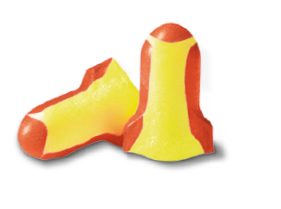
Noise Reduction: Typically 28-33 dB SNR
Best for: Manufacturing environments, construction sites, general industrial work where high attenuation is needed and communication isn’t critical. These disposable plugs are cost-effective for high turnover situations and work well in dusty or dirty environments where reusable options might become contaminated.
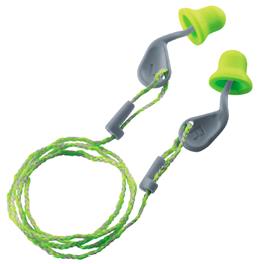 Pre-Moulded Reusable Earplugs
Noise Reduction: Typically 20-27 dB SNR
Best for: Warehouse operations, logistics and light manufacturing. Their reusability makes them economical for regular users, and they’re often more comfortable for extended wear. Many feature stems for easy insertion and removal with dirty hands.
Detectable Earplugs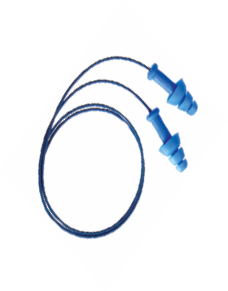
Noise Reduction: 20-30 dB SNR (depending on design)
Best for: Detectable earplugs are safety-focused, metal-infused hearing protection designed for food, pharmaceutical, and contamination-sensitive industries. They feature metallic components (often in the plug and cord) detectable by X-ray and metal detection equipment, alongside high-visibility colors (usually blue) to prevent contamination.
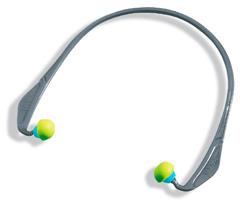 Banded Earplugs
Noise Reduction: Typically 22-27 dB SNR
Best for: Banded earplugs are best for people who need quick, convenient, and intermittent hearing protection in loud environments such as construction, manufacturing, mining, forestry, aviation, military settings, or for shooting sports, concerts, travel, and sleep, offering fast insertion and easy access around the neck.
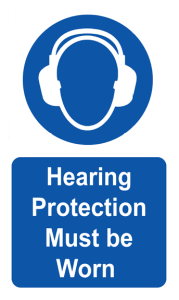
Passive Ear Defenders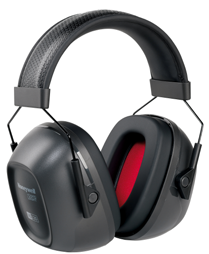
Noise Reduction: 20-34 dB SNR
Best for: Airports, shooting ranges, demolition work, heavy construction, and metalworking. Ear Defenders are excellent when workers move in and out of noisy areas frequently, as they’re easy to don and doff. They’re also suitable when earplugs aren’t feasible due to ear canal issues or hygiene concerns.
Selecting the Right Protection for the Job – Continued…
Communication Headsets with Hearing Protection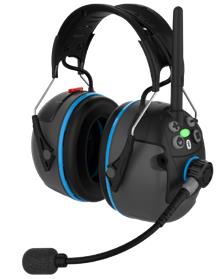
Noise Reduction: Varies, typically 20-30 dB with integrated communication systems.
Best for: Sites where team coordination is essential. These combine hearing protection with two-way radio communication, solving both protection and communication challenges simultaneously.
Making the Right Choice
The HSE emphasises that hearing protection should be selected based on proper noise assessments, not guesswork. Employers must measure workplace noise levels and choose protection that:
• Reduces noise exposure to below 85 dB(A) over an 8-hour period
• Allows workers to hear warning signals and communication
• Is comfortable enough to encourage consistent use
• Suits the specific working conditions and tasks
Remember, hearing loss is permanent. This World Hearing Day, take the time to ensure your hearing protection strategy strikes the right balance—protecting your hearing without compromising your safety. When in doubt, consult with occupational health professionals who can conduct proper noise assessments and recommend appropriate protection for your specific environment.


