



When it comes to chemical safety in the workplace, the smallest exposures can lead to the most serious consequences. That’s why the selection of chemical protective equipment, especially gloves, must be grounded in more than surface-level durability. Two critical factors that safety managers must understand when evaluating chemical protective materials are permeation and cumulative permeation.
These parameters are essential in assessing how effectively a glove or garment can prevent hazardous chemicals from reaching the skin over time and for how long the protection holds.
What Is Permeation?
Permeation refers to the process by which a chemical passes through a protective material on a molecular level. This movement can happen even without any visible signs of wear or damage. Unlike penetration (which occurs through holes, cracks, or tears) or degradation (which alters the material’s structure), permeation is invisible and gradual but no less dangerous.
To measure permeation, standardised lab tests such as EN 16523, EN 374, and ASTM F739 are used. In these tests, a chemical is placed in constant contact with one side of the PPE material, while sensitive detectors measure how long it takes for the chemical to begin breaking through to the other side.
This measurement is called the Breakthrough Time (BT) – the time it takes for the chemical to permeate the material at a specific rate, such as 1.0 μg/cm²/min according to EN standards. The longer the BT, the more resistant the material is to that particular chemical.
Why Cumulative Permeation Matters
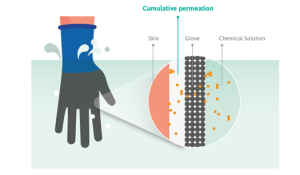
While BT is an important benchmark, it only tells part of the story. That’s where cumulative permeation, also referred to as cumulative mass, comes into play.
Cumulative permeation is the total amount of chemical that has passed through a material over time, usually measured in microgrammes per square centimetre (μg/cm²). This measurement helps estimate the chemical dosage a worker may be exposed to during prolonged contact, even if the breakthrough rate hasn’t yet been reached.
For example, imagine a chemical glove that shows a BT greater than 480 minutes, a seemingly excellent result. However, over that period, a cumulative mass of 420 μg/cm² could still pass through. If the average surface area of both hands is around 360 cm², the total chemical exposure could reach over 150 milligrammes, a significant and potentially harmful dose.
This reinforces a critical point: A long breakthrough time doesn’t necessarily mean the glove is safe for extended wear. Cumulative exposure must be factored into the decision, especially for highly toxic chemicals.
Estimating Safe Wear Time
To make an informed decision on safe wear time, you’ll need to consider both the BT and cumulative permeation values in relation to several key factors:
- Toxicity and skin absorption of the chemical
- Contact duration and whether it’s a splash or full submersion
- Environmental conditions, including temperature and humidity
- Secondary hazards, such as the risk of cuts or punctures
By cross-referencing these considerations with permeation and cumulative mass data, you can better estimate how long PPE can be worn before it becomes unsafe.
The Role of Standards
Standardised test methods help create consistency across PPE evaluations:
- EN 16523 and EN 374 (Europe): Define permeation testing and performance classification for chemical protective gloves
- ASTM F739 (USA): A key method for measuring the permeation rate and breakthrough time.
- ISO 6529 (International): Covers both permeation and degradation testing
Understanding how to interpret data from these standards ensures that chemical PPE is selected not only for compliance, but also for practical, real-world protection.
How AnsellGUARDIAN™ Chemical Helps

Selecting the right PPE can be overwhelming, especially when dealing with hundreds of chemicals and varying workplace conditions. That’s where AnsellGUARDIAN™ Chemical steps in. This specialised service is designed to help you make smarter, safer PPE choices by offering:
- Tailored product suggestions based on your specific chemical hazards and workplace applications
- Access to a comprehensive database of permeation and degradation data covering thousands of gloves and chemical combinations
- Live chemical test data to guide precise selection
- Expert insights on complex chemical mixtures and custom exposure scenarios
AnsellGUARDIAN™ Chemical doesn’t just help you comply, it helps you optimise. With the support of data-driven recommendations and real-world expertise, you can protect your workers more effectively and improve workplace safety outcomes. Contact us for a free AnsellGUARDIAN™ Chemical assessment.


