

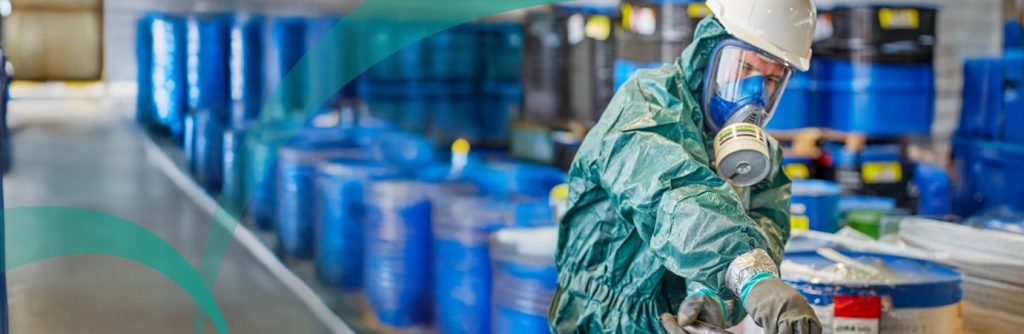

Each day, workers are exposed to hazardous substances that carry significant safety risks. Depending on the toxicity of the chemicals involved, even limited exposure can have life-threatening consequences. The selection of appropriate personal protective equipment (PPE) is not just a regulatory requirement – it’s a life-saving decision. Safety managers face a complex matrix of variables when choosing chemical-resistant PPE. Factors like the type of chemical, exposure time, mixture interactions, and environmental conditions all play a crucial role in determining the right protective gear.
Understanding How Chemicals Interact with PPE
To select the right PPE, it’s essential to understand how hazardous substances compromise protection. Chemical agents interact with PPE in 3 primary ways:
Penetration – This occurs when chemicals pass through defects in the PPE material, such as tears, punctures, or inherent porosity. It’s a physical breach, and once detected, the PPE must be replaced immediately.
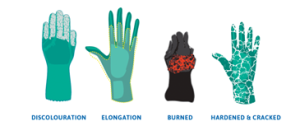
Degradation – Chemical contact can cause material deterioration, such as discolouration, swelling, elongation, burned or cracking. Degraded gloves or garments may no longer provide effective protection and should be discarded upon detection of these changes.
Permeation – Unlike penetration, permeation is an invisible, molecular process. Chemicals adsorb to the PPE surface, diffuse through the material, and desorb on the inner side. Even without visible changes, used PPE may continue to allow harmful chemicals to pass through.
The Reusability Question
You might ask, “Can I reuse chemical PPE?” The answer depends on the chemical’s properties, the PPE’s material, and exposure duration. Reusing chemical PPE is risky when dealing with permeable substances or if it has been exposed to complex mixtures. Visual inspection alone is insufficient. Permeation can occur even when the PPE looks intact.
Why Breakthrough Time Isn’t the Whole Story
PPE standards such as EN ISO 374, ISO 6529, and ASTM F739 test how long it takes for chemicals to permeate PPE materials – this is known as the “breakthrough time.” However, relying solely on breakthrough time can be misleading. It reflects a lab condition under controlled settings and doesn’t consider real-world factors like chemical toxicity or environmental temperature.
A material with a breakthrough time of >480 minutes might still allow enough chemical to pass through in the first 60 minutes to be harmful, especially if the substance is toxic at low concentrations.
The Role of Cumulative Permeation
Cumulative permeation measures the total amount of a chemical that passes through a given area over time. This metric is especially critical for substances with chronic toxicity risks such as skin sensitisers or carcinogens – which may cause harm even with low-level, long-term exposure.
When dealing with toxic substances, choosing PPE with lower cumulative permeation – even if the breakthrough time is shorter, can be a safer option.
Real-World Variables That Affect PPE Performance
Lab-tested data should always be adapted to your specific worksite conditions. Factors that influence PPE effectiveness include:
Chemical toxicity – High-toxicity substances require stricter control on both breakthrough time and cumulative exposure.
Temperature – Elevated body, chemical, or ambient temperatures can increase permeation rates.
Mechanical risks – Tasks involving abrasion or puncture hazards can weaken PPE and accelerate chemical breaches.
Exposure type – Immersion, splashes, vapours, and sprays each affect PPE differently.
Chemical mixtures – Real-world chemicals often come in combinations. Synergistic effects can reduce protective performance or create entirely new hazards.
Why Safety Managers Need a Smarter Tool
With so many variables at play, you can’t rely on guesswork or generic charts. They need data-driven support that accounts for specific chemicals, real use conditions, and up-to-date test results. That’s where AnsellGUARDIAN™ Chemical steps in.
Optimise Your PPE Strategy with AnsellGUARDIAN™ Chemical

AnsellGUARDIAN™ Chemical is a powerful digital tool built to simplify the selection of chemical protective equipment. Backed by a database of over 41,000 chemicals, including many mixtures, it provides detailed permeation and degradation data tailored to real-world applications.
By using AnsellGUARDIAN™ Chemical, you can:
- Access expert-tested data for gloves and suits across a broad chemical spectrum
- Evaluate and compare materials based on both breakthrough time and cumulative permeation
- Get PPE recommendations specific to your industry and chemical hazards
- Make more confident decisions on wear time, reuse, and protection levels


